

Online vCard QR Code Generator
Create a static vCard QR code so people can save your contact details to their phone with one scan. Add a name, phone number, email, company, job title, address, or website, and the generator will turn that information into a QR code for business cards, badges, resumes, email signatures, and contact pages.
A static vCard QR stores the contact data directly inside the QR code. After scanning it, a smartphone can display a ready-to-save contact card and offer to add it to the address book without typing the phone number or email by hand.
If you need an editable online business card with a photo, social links, messengers, a portfolio, and the ability to update details after printing, use Digital Business Card after signing up.
Create a vCard QR code in the generator
This generator is designed for a simple static vCard QR code. It does not send people to a website or open a separate profile page. Instead, it passes contact details in a format that smartphones can recognize as a new contact.
Fill in the fields you need, generate the QR code, and test it on a smartphone before using it. For most QR business cards, a name, phone number, email, company, job title, and website are enough. This keeps the data compact and works well on smaller printed materials.
💡 If you want to include a lot of information, multiple links, social profiles, or a full profile page, consider Digital Business Card from the start. A static vCard QR works best when the contact is short, clear, and not overloaded with extra fields.
How saving a contact through a QR code works
The experience feels simple for the person scanning it, but the logic is precise. You enter contact details into the form, the generator creates a vCard record, and then encodes it into a QR code. When someone scans the code, their smartphone recognizes the contact card and offers to save it to the phone.
In a static vCard QR, the contact details are stored directly inside the code. That is why scanning this type of code does not require internet access: the phone reads the information from the QR code and shows a prepared contact.
With Digital Business Card, the flow is different. The QR code opens an online business card, so internet access is required to view the profile. In return, you can update the details after printing without replacing the QR code.
What information you can add to a vCard QR code
Add only the contact details a person will actually need after scanning. The shorter and cleaner the contact, the more compact the static QR code will be.
- First and last name. This is the main contact field that makes a person or company easy to find in the address book after saving.
- Phone number. The key field for quick communication. For a compact QR code, it is usually better to add one primary number instead of several secondary ones.
- Email. Useful for business contacts, resumes, consultations, commercial inquiries, and follow-up communication after the first meeting.
- Company and job title. These fields make it clear who has been saved and in what context the interaction happened.
- Website or profile page. You can add a company website, portfolio, specialist profile, or page with additional information.
- Address or short note. These fields are useful for local businesses, offices, clinics, salons, and service professionals, but use them sparingly so the QR code does not become overloaded.
For most QR business cards, a name, phone number, email, company, and website are enough. If you need to add a photo, many social links, several contact channels, a portfolio, or a longer profile description, Digital Business Card is the better fit.
Where to use a vCard QR code
A vCard QR code is useful when someone needs to save a contact to their phone quickly, not just open a link. You can add it to offline and online materials where contact details should be easy to save without manual typing.
Business cards
Place a vCard QR code on the front or back of a printed business card. After scanning, a person can save your name, phone number, email, company, and job title without typing them manually. This reduces mistakes in phone numbers or email addresses and makes the printed card more useful after the meeting.
Event badges
A QR code on a badge makes networking easier at conferences, trade shows, forums, and business events. Instead of exchanging paper cards, an attendee can show the badge and the other person can save the contact in a few seconds.
Resume or CV
A vCard QR code in a resume helps a recruiter save your phone number and email quickly. It is especially practical for PDF resumes, printed CVs, and short one-page resumes where contact details should be visible without taking up much space.
Email signature
A QR code in an email signature can be scanned from a laptop or monitor and saved directly to a smartphone. This is useful for sales teams, consultants, freelancers, service specialists, and anyone who regularly communicates with new clients.
Flyers and promo materials
A vCard QR code on a flyer, leaflet, or ad helps a customer save the contact of a company, manager, technician, or consultant without searching for the number manually. It works well for local services, service businesses, consultations, and short promotional campaigns.
Catalogs and presentation materials
In catalogs, proposals, and printed presentations, a vCard QR code can be placed next to the contact details of the responsible manager or sales department. This makes it easier to return to the right person after reviewing the materials.
Reception desk
Salons, clinics, studios, service centers, and offices can place the QR code at the reception desk. A customer scans the code and saves the official number for booking, consultation, or a later visit.
Contact page
A vCard QR code on a website helps visitors move your contact details from the browser to their phone. This is useful for companies, professionals, and local businesses that want contact information to be easy to save, not just visible.
Virtual background for online meetings
You can add a vCard QR code to a virtual background in Zoom, Google Meet, or Microsoft Teams. During a call, participants can scan the code from the screen and save your contact without a separate chat message.
Static vCard QR vs Digital Business Card
On fbfast.io, there are two contact-sharing options: a static vCard QR and Digital Business Card. Both help you share contact details, but they work differently and are better suited to different needs.
A static vCard QR code is created with the form on this page. It stores contact details directly in the QR code: name, phone number, email, company, job title, address, or website. This type of code can be scanned without internet access, but it cannot be edited after it has been created.
Digital Business Card is an editable online business card available after signing up. The QR code opens an online profile, and the information can be updated in your account without replacing the QR code itself. This format is a better choice when contact details may change or when you need more than basic fields: a photo, social links, messengers, a portfolio, or a fuller profile.
| Option | Static vCard QR | Digital Business Card |
|---|---|---|
| Can be created without signing up | Yes | Yes |
| Contact details are stored directly in the QR code | Yes | No |
| Works without internet access during scanning | Yes | No |
| Details can be changed after printing | No | Yes |
| The QR code stays the same after updates | No | Yes |
| Can include a photo, social links, and a fuller profile | No | Yes |
| Suitable for a simple QR business card | Yes | Yes |
| Suitable when phone, email, or job title changes often | No | Yes |
| Suitable for printing on business cards and badges | Yes | Yes |
If you need an online business card that can be updated after printing, create a Digital Business Card after signing up.
When to choose a static vCard QR
Choose a static vCard QR when you need to create a simple contact QR code quickly, without signing up or configuring advanced settings. It is a good fit when your contact details are stable and the main goal is to let someone save your phone number, email, or website fast.
- Your contact details rarely change. If your phone number, email, company, or job title will stay valid for a long time, a static vCard QR works well for business cards, badges, resumes, and email signatures.
- You need fast basic contact sharing. This QR code is practical for introductions, consultations, events, and printed materials where the goal is to share contact details rather than send someone to a separate page.
- Offline scanning matters. Since the contact is stored directly inside the QR code, a smartphone can read it even without a network connection.
- You do not need post-print editing. If you do not expect to change the details on already printed materials, a static vCard QR stays simple and practical.
💡 If your phone number, email, or job title may change soon, it is better to consider Digital Business Card from the beginning.
When Digital Business Card is the better option
Choose Digital Business Card when the QR code needs to stay in use for a long time and the contact details may change after printing. It is not just a contact QR code. It is an editable online business card that you can update in your account.
- You need to update details without replacing the QR code. If the phone number, email, job title, or company may change, Digital Business Card lets you update the information without reprinting business cards, badges, or promotional materials.
- You need a richer profile. Digital Business Card is a better fit if you want to add a photo, social links, messengers, a portfolio, a service description, or several ways to get in touch.
- The QR code will be printed for long-term use. If the code appears on business cards, catalogs, packaging, signs, or other materials that are hard to replace quickly, an editable online business card lowers the risk of outdated contact details.
- You need a professional digital presence. For teams, specialists, salespeople, consultants, and companies, Digital Business Card can work as a compact profile page, not only as a contact for an address book.
If you need a simple contact QR code without editing, a static vCard QR is enough. If the details may change after printing or the profile needs more information, Digital Business Card is the better choice.
What to do if a vCard QR code becomes too dense
A static vCard QR code stores contact details directly inside the code. The more information you add, the more complex and dense the QR code becomes. Small modules can then be harder to scan, especially on printed business cards, badges, or in poor lighting.
A QR code usually becomes too dense because of long addresses, large notes, several phone numbers, many links, or very long URLs. For a static vCard QR, keep only the data that is truly needed to save the contact.
- Keep one primary phone number. Multiple numbers make the contact longer and increase QR code complexity. If additional contact channels are not essential, move them to Digital Business Card.
- Shorten the address or website. Long physical addresses and URLs can noticeably increase QR code density. If the address is not needed for the first contact, leave it out.
- Do not overload the note field. NOTE is best used for brief service information, not for service descriptions, biographies, or long explanations.
- Keep the core fields. For most QR business cards, a name, phone number, email, company, and website are enough. This usually creates a cleaner code that scans more reliably.
Why different phones may display a vCard differently
The vCard format is supported by most modern smartphones, but different cameras, scanners, and address books may handle individual contact fields in slightly different ways.
For example, one phone may show company name and job title in separate fields, while another may move part of the data into a note. Some scanners work better with vCard 3.0, others with vCard 4.0. Individual apps may also handle addresses, multiple phone numbers, or non-standard fields differently.
Most issues are not caused by the QR code itself, but by how a specific scanner or phone interprets the vCard structure.
- Use standard fields. Name, phone, email, company, job title, and website are usually recognized more consistently than complex or non-standard fields.
- Do not overload the contact. The more data you put into a vCard, the higher the chance that a scanner or address book will display part of it differently than expected.
- Test on different devices. Before printing, check the QR code on iPhone, Android, and a few popular scanner apps, especially if it will be used by a broad audience.
- Check the vCard version. If the generator supports multiple versions, test vCard 3.0 and 4.0 on the devices people will actually use.
vCard QR limitations and privacy
A vCard QR code is useful for quick contact saving, but it has a few practical limits. Consider them before adding the QR code to a business card, badge, resume, or marketing material.
A static code cannot be edited after creation. If a phone number, email, or job title changes, you need to create a new QR code and replace it on your materials. If post-print editing matters, Digital Business Card is the better option.
Fields may appear differently. Different smartphones and scanners can process vCard fields in slightly different ways. One device may place company and job title correctly, while another may show part of the data as a note.
The data inside the QR code is public. Anything stored in a static vCard QR can be seen by anyone who scans it. Do not add private information that you do not want to share publicly.
Frequently Asked Questions
What is a vCard QR code?
A vCard QR code is a QR code with contact details stored in vCard / VCF format. After scanning, a smartphone can recognize the data as a contact card and offer to save it to the address book.
What information can I add to a vCard QR code?
A vCard QR usually includes first name, last name, phone, email, company, job title, website, address, and a short note. For a static QR code, keep only the necessary fields so the code stays compact and scans more reliably.
Do I need internet access to scan a vCard QR?
A static vCard QR does not require internet access because the contact details are already stored inside the QR code. Digital Business Card requires internet access because scanning opens an online business card.
How is a vCard QR different from Digital Business Card?
A static vCard QR stores contact details directly in the code and is made for quickly saving a contact to a phone. Digital Business Card is an editable online business card that you can update in your account without changing the QR code itself.
Why did my vCard QR code become very dense?
The most common reason is too much data. Long addresses, several phone numbers, many links, and large notes increase the complexity of a static QR code. To make the code more compact, keep the core fields: name, phone, email, company, and website.
Why does my phone display some fields incorrectly?
Different cameras, scanners, and address books may process the vCard format differently. If important fields display incorrectly, simplify the contact, remove non-standard data, and test the QR code on several devices.
Which vCard version should I choose?
For most QR business cards, vCard 3.0 offers the best balance of compatibility. vCard 4.0 is newer, but before printing it should be tested on the phones and scanners people will actually use.
Can I add a photo to a vCard QR code?
For a classic static vCard QR, photos are usually avoided because they greatly increase the data size and make scanning harder. If you need a photo, social links, messengers, or a portfolio, create a Digital Business Card instead.
📘 Useful articles from our blog
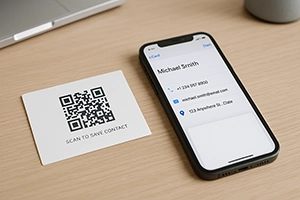
What is a QR business card, how to create one, add social networks, a logo, and your data — an example of a new-generation digital business card.
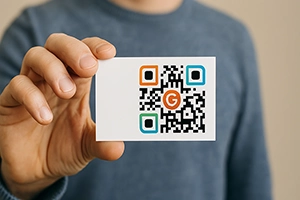
Customization guide: colors, logos, frames. How to create a branded code that stands out.
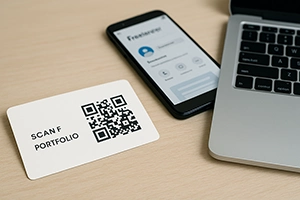
Digital business card, landing page, resume — how freelancers can share information quickly via scan.