QR Code Analytics: Turn Offline Attention Into Measurable Data
Offline marketing is still powerful, but it often leaves teams guessing. You can print thousands of flyers, launch billboard placements, or refresh your product packaging and still struggle to prove which touchpoint actually moved people to act.
QR code analytics closes that gap. It creates a measurable link between a physical surface and your digital funnel. With dynamic QR codes in FbFast, each scan becomes a data point that helps you understand interest, geography, timing, and the real contribution of each offline campaign.
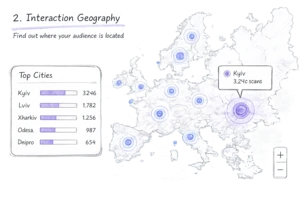
What You Can Learn From Every Scan
Every visit through a dynamic QR code is recorded in real time. Instead of treating a QR code like a static image, you get a dashboard with signals you can use to improve future campaigns:
- Total and unique scans. This helps you separate raw traffic volume from actual audience reach. Unique scans show how many people engaged, while total scans reveal how often users came back to the same code.
- Location-based engagement. You can see the cities and countries where scans happen. That matters when you need to compare placements, such as a central retail location versus a residential district or one region against another.
- Device types and browsers. Knowing whether your visitors arrive from iPhone, Android, or specific mobile browsers helps you check landing page compatibility and tailor the next step of the user journey.
- Peak activity windows. Scan trends by hour and day of week help you spot when people are most likely to interact. That insight is useful for retargeting, post timing, and coordinating offline activity with digital follow-up.

Advanced Tracking for Teams That Need Attribution
Basic scan counts are useful, but they are rarely enough for a serious marketing workflow. If you want to calculate customer acquisition cost or understand return on investment, offline interactions need to connect to the rest of your stack.
UTM Parameters for Google Analytics 4
Without tagging, QR traffic often lands in analytics as generic direct traffic, which hides the real source. FbFast lets you add parameters like utm_source, utm_medium, and utm_campaign directly to the destination URL so GA4 can treat each offline initiative as a distinct channel.
CRM Attribution and Lead Source Tracking
When QR-driven traffic feeds into a CRM such as HubSpot, Pipedrive, or Bitrix24, you can preserve source context from the first scan to the eventual lead. That makes it easier to see which printed asset, venue, or in-store surface contributed to a real business outcome.
Where QR Analytics Creates the Most Value
Scan tracking matters most when you are investing money, shelf space, or customer attention and need to judge the quality of that interaction instead of relying on assumptions.
- FMCG and product packaging: Add a dynamic QR code to labels and inserts to understand where customers engage most often and how frequently they open digital guides, onboarding flows, or product support content.
- Hospitality and retail: Use QR codes on receipts, table tents, window displays, or in-store signage to measure promotion performance and identify when digital menus or loyalty flows get the most traffic.
- Events and conferences: Place separate QR codes on attendee badges, speaker slides, booths, or sponsor materials to see which touchpoints generated the strongest response during the event.
- Print A/B testing: Keep the layout consistent but vary the message or call to action. Separate QR codes for each version show which wording attracts more interest before you scale the campaign.

Limits of the Technology: When Analytics Is Useful and When It Is Not
QR analytics is valuable, but it is not universal. The tracking model has clear technical boundaries, and understanding them helps you choose the right kind of QR code for each use case.
Static QR Codes Are the Better Choice for Fixed Data
Analytics works only with dynamic QR codes because the scan goes through a short redirect URL that records the visit before forwarding the user. If your goal is simply to share a Wi-Fi password, a phone number, or plain text that should work without an internet connection, a static QR code is usually the better option.
An Internet Connection Is Required for Tracking
A scan can only be counted when the device actually reaches the server. If someone scans the code in an underground parking garage, on a poor network, or anywhere without coverage, the redirect may fail and no analytics event will be recorded.
Privacy Still Matters
QR code analytics is not a surveillance tool. It works with technical, non-personal signals such as device type, city-level location, and timestamp. You do not learn a person's name, phone number, or exact address unless they willingly submit that information through a form after landing on your site.
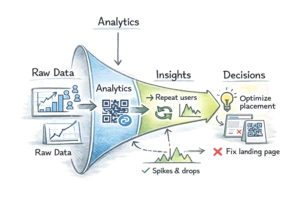
How to Read Scan Data Without Reaching the Wrong Conclusion
Collecting metrics is only the first step. The real value appears when you interpret those numbers in context and use them to adjust placements, offers, or landing pages. Here is what to look at first:
Total Scans vs Unique Scans
Unique scans tell you how many people engaged at least once. Total scans show how often the code was opened overall. If you see 100 unique scans and 400 total scans, that usually means the code remains useful after the first visit, as with a digital menu or schedule. If both numbers are almost identical, the interaction is probably one-time only.
Spikes and Drop-Offs
A sudden jump in scans can signal a well-timed placement, a live event, or a change in exposure. A sharp decline from a previously active code often points to a physical problem: the poster may have been removed, the label may have faded, or the QR code may no longer scan reliably.
Placement Context Matters More Than Ego Metrics
High scan volume does not automatically mean the creative is excellent. Often it simply reflects the context. A code on a restaurant table or at a bus stop has more time and attention available than one on a roadside billboard where people cannot safely stop and scan.
A Scan Is Interest, Not a Conversion
A QR scan is closer to a click than to a completed sale. If the dashboard shows strong traffic but the campaign is not producing orders or signups, the bottleneck is often the landing page experience rather than the offline placement itself.
Common Mistakes That Distort QR Analytics
Data is only useful when it stays clean. Many teams damage their own reporting by setting up QR campaigns in ways that hide the real source of results.
Using One QR Code Across Every Placement
If the same code appears on flyers, subway posters, and tabletop displays, the dashboard can only show blended traffic. You will know that people scanned, but not which channel justified the spend. Separate dynamic codes or distinct UTM tags make the data readable.
Sending Traffic to a Weak Mobile Experience
QR scans happen on phones. If the landing page is slow, hard to use, or asks for too much too soon, people leave before converting. That creates a misleading situation where scan numbers look healthy but business performance stays flat.
Judging Success by Scan Volume Alone
A scan is a signal of curiosity, not proof of revenue. If you celebrate raw traffic without comparing it to orders, bookings, registrations, or another business outcome, you are optimizing for a vanity metric instead of campaign value.
Launching Without One Clear Goal
A QR code should always support a concrete next step: open a menu, claim a coupon, start a chat, download an app, or submit a form. Without a defined goal, the analytics become a pile of numbers that is hard to act on.
What QR Code Analytics Can Show and What It Cannot
In modern marketing, the line between useful measurement and intrusive tracking matters. QR code analytics is designed to evaluate campaign performance, not to identify individuals behind each scan.
What You Can See at the Interaction Level
When someone scans a code, the platform can register device-level technical context such as operating system, browser, approximate city based on IP, time of visit, and total scan activity. That is usually enough to compare placements and audience response patterns.
What You Cannot Know Without Consent
A QR code cannot secretly extract a person's phone number, name, email address, or social profile from their device. The tracking layer has no direct access to personal contacts or private account data.
How to Turn Anonymous Scans Into Leads Ethically
If you want contact details, the QR code should lead to a landing page with a clear value exchange, such as a discount, downloadable price list, booking form, or gated resource. That is how you convert anonymous interest into an identifiable lead in a compliant and transparent way.
Start Measuring Offline Performance With More Confidence
Stop investing in print and offline promotion without feedback loops. Create your first dynamic QR code in FbFast, add campaign tags, and track every scan in one dashboard so offline attention becomes something you can actually measure and improve.